Georgia-based author and artist, Mary has been a horror aficionado since the mid-2000s. Originally a hobby artist and writer, she found her niche in the horror industry in late 2019 and hasn't looked back since. Mary's evolution into a horror expert allowed her to express herself truly for the first time in her life. Now, she prides herself on indulging in the stuff of nightmares.
Mary also moonlights as a content creator across multiple social media platforms—breaking down horror tropes on YouTube, as well as playing horror games and broadcasting live digital art sessions on Twitch.
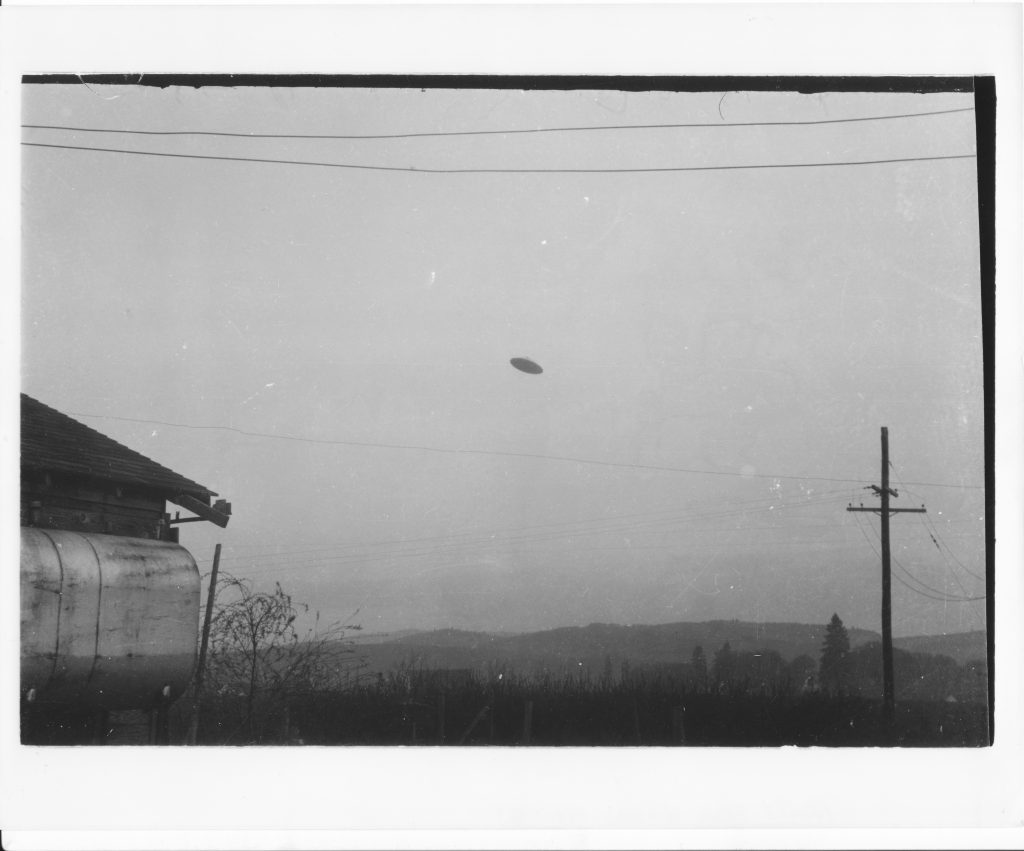
One of the most famous pictures of a UFO was taken in 1950 on a farm near McMinnville—this controversial photograph showed what looked to be a flying saucer in the sky and was even printed all across the country in both newspapers and magazines, including Life. The problem is, is that it has still not been disproved and there is still no one who really knows the truth of the photograph.
Timeline of Events and Investigation
1950
Photography by Paul Trent
Between 7:30 and 7:45 pm in May, Evelyn Trent was out feeding their rabbits in the yard of the couple’s farm and saw “… a good-sized parachute canopy without strings, only silver-bright mixed with bronze,” which prompted her to yell for her husband. When her husband didn’t come out, she ran into their house to find him and their camera, before they both raced back into their yard. When Paul saw the object as well, later describing it as, “a round, shiny, wingless object,” that was hovering in the sky. Evelyn would later describe what they had saw that night, “as pretty as anything [she] ever saw.”
That night, the 43-year-old farmer was able to take two photographs before the flying object disappeared into the evening mist, and there has never been a more popular photograph to ever come out of Yamhill County. The images weren’t published until about a month after they were taken, because they wanted to finish off the roll before getting the images developed, in The McMinnville Telephone Register and The Oregonian. Life magazine followed up with publishing the story and images after the Oregon publications, which allowed the entire nation to marvel over the unidentified flying object. It didn’t take long for an investigator from the U.S. Air Force to make a trip to visit the Trents on their farm outside of McMinnville. “The object was coming toward us and seemed to be tipped up a little bit,” Paul Trent offered up to the investigations officer, “it was very bright—almost silvery—and there was no noise.”
This particular investigator had heard about these kinds of stories before, it was the Golden Age of UFO sightings, after all—however, most of all the other alien sightings had been easily debunked. Unlike the others, this was no weather balloon, private planes, or otherwise obvious hoaxes.
In 1967, Condon led an exhaustive UFO study and finally finished a 950-page report under the name, “Scientific Study of Unidentified Flying Objects,” which dismissed most of the reported sightings, but then stated that, “at least one, showing a disk-shaped object in flight over Oregon, is classed as difficult to explain in a conventional way.” This study determined that the photos were genuine and that the Trents were honest in their reports.
Condon’s study declared that it was, “one of the few UFO reports in which all factors investigated—geometric, psychological and physical—appear to be consistent with the assertion that an extraordinary flying object, silvery, metallic, disk-shaped, tens of meters in diameter and evidently artificial, flew within sight of two [credible] witnesses.”
Until both Evelyn and Paul passed away in the late 1990s (Evelyn in 1997 and Paul in 1998), they maintained that their story was genuine and even modern analysis doesn’t provide absolute results as to whether or not the images can be debunked. It seems that skeptics believe it’s a hoax, whereas believers assert that it’s evidence that cannot be discounted on the existence of UFOs. The only thing that has been proven over the years since the photograph was taken, is that even under intense scrutiny it can neither be definitively debunked nor confirmed.
2004
Researcher Joel Carpenter (1959-2014) attempted to recreate a plausible UFO picture on the Trents’ farm, but it was clear the picture was shot using optical illusions to make it seem as if a near object was actually in the distance.
What are your thoughts on this very long-survived UFO sighting that still refuses to be debunked with confidence? Do you believe that these 70-year-old pictures could possible be authentic, or are they the best surviving hoax that has ever been captured on film? Let us know your thoughts below!
Georgia-based author and artist, Mary has been a horror aficionado since the mid-2000s. Originally a hobby artist and writer, she found her niche in the horror industry in late 2019 and hasn’t looked back since. Mary’s evolution into a horror expert allowed her to express herself truly for the first time in her life. Now, she prides herself on indulging in the stuff of nightmares.
Mary also moonlights as a content creator across multiple social media platforms—breaking down horror tropes on YouTube, as well as playing horror games and broadcasting live digital art sessions on Twitch.
I looked up at the loft in my father’s study, my eyes burned from a lack of sleep, but if I was ever going to get broken in to some of the insane notions that my father spoke about the night before this was how I should do it. I felt his hand grasp my shoulder and the kiss he gave me on the back of my head, as he encouraged me to do the deed.
“Oh Anna, it’s not that bad,” he chuckled as he watched me climb the wooden loft steps.
“JESUS CHRI—”
“You watch your mouth young lady!” I heard him snap, as he stood in his office below.
“What is all of this stuff, Da’?” He couldn’t really blame me for my initial reaction, his loft seemed to extend the length of the entire house and not just over his own study. It was also filled with boxes, filing cabinets, and the odd armoire—speaking of which, how the hell did he even get that up there?
“Oh, don’ ye touch the armoire!” I heard him shout as he had read my mind when he settled back in front of his computer, “that’s a story fer another day!”
“You don’t expect me to get through all of this today do you?” the incredulous tone in my voice came out without my permission, but dad already knew the kind of sass that I brought to the table.
“Nah, jus’ find Oregon, seein’ ye already met Rue.” I heard him chuckle to himself, as if he had just remembered a funny joke and I could almost feel my eyes roll into the back of my head.
Oregon, Oregon—my eyes scanned the boxes, he told me he wasn’t going to help me go through anything, but that I had to go through it. I figured it wouldn’t hurt to go through a few notes he’d collected on the subject. This, however, was far and away beyond a few notes that he had alluded to. Finally, I found a box against the wall that was labeled Oregon, it was sitting on a stack of boxes—also labeled Oregon—shit, I knew it, I was going to be here all night. I grabbed the top box and wrestled it over to the desk that sat in front of the octagonal loft window, where radiant light filtered through.
“Well, here goes nothing,” a sigh escaped my chest and I threw back the dusty lid of the first box of many that I was charged with reading through and memorizing. I quickly scanned the file names for the Heceta Head Lighthouse, but was disappointed to find there was nothing about it in this particular box. Another file name caught my eye though, LAFAYETTE, OR – WITCH’S CURSE, father’s handwriting neatly headed the label. My curiosity was piqued now, I had to read this one first.
The year was 1885 and the Willamette Queen had just pulled into the dock of Lafayette, Oregon. Despite the early hour, the skies were gloomy, overcast, and the clouds threatened to batter all that which laid below. Locals disembarked with a spring in their step to meet their families who had gathered to welcome them home, while others shuffled off in a daze as they attempted to gather themselves. One such family, a man as well as his wife and mother stepped off to the side; they looked around for a moment and after a brief conversation with a local street vendor, set off down one of the muddy dirt roads that led into downtown.
Sheriff Harris, propped up on his horse, eyed the newcomers into his town and noted all of the people with which he would become acquainted in the days to come. He was a relic of older times and practices; his hat, brown duster coat, and boots proved as much, the splatters of dried mud gave away his hands-on approach to his livelihood.
The Marple family had recently become settled in a home on the outskirts of town, the matron of the family, Anna Marple had already become a name on the lips of the townspeople. As a widow, it was not unusual for her to live with her son and his wife, but she never seemed to act her part. The other women of the town shunned her, gossip telephoned from one ear to the next, and there always seemed to be some small scandal or another lingering around her. This didn’t seem to matter to one David Corker, a lonely widowed shop owner; she had caught his eye nearly the first day she and her family disembarked from the Willamette Queen that dreary fall day in 1885. Anna had gained a reputation of being a very unchristian woman, her traditional black widow’s clothing turned heads, children ran when she came walking into town, and there always seemed to be a raggedy black cat that trailed behind her wherever she went. Folks in those parts believed the widow Marple to be a witch, but the topic was never broached in proper company.
I am beginning to suspect my husband’s mother is making sinister plans for me; I fear that my mouth has become too much for her to stand to provide food for. I have no money to my name and my only contribution is that I keep a tidy home. I am quite proud of that fact, if I am to be frank, I was raised to be a homemaker after all. That of course seems to be of no consequence to my husband’s mother.
Julie Marple – May, 1886
Seasons had passed in the town of Lafayette, the summer had been a prolific one for the townspeople and consequently the burglaries had been numerous. The widow Marple had effortlessly acquired the company of the widower Corker, who had earlier that year begun the process of courting the target of his affections. This of course spawned more gossip and rumors, of the widow having Mr. Corker under some type of spell. The sheriff of course had more important things to worry about, mostly the burglaries that had been occurring in the middle of the night—and at present he only had a single suspect. It of course didn’t help that the description of the perpetrator had matched quite exactly with the lanky, sallow Mr. Marple with his dark and greasy long hair.
The Marple residence had been frequented by Sheriff Harris on many occasions, mostly due to complaints by other townspeople, but recently it had more to do with the fact that before their arrival the theft of property had been a rarity in his town. There was just nothing else that could be said on the matter, in fact, the only thing Harris could do was charge him with a crime—but the evidence supporting his theory was severely lacking. It would just have to wait.
The fall of 1886 came quickly, like the changing of the leaves, it was there before anyone could realize it was even happening. Sheriff Harris continued to get more reports of burglaries in the area and he knew he would have to do something about it soon, or risk his own unemployment. Luckily for Harris, what happened on November 1, 1886 was exactly what he needed to solidify a case that would take Marple off of his streets for good.
Let me start by saying I did it, of course, I did it. Who else could have? Who else would have? We haven’t been living in Lafayette for very long, but it feels like forever when no one will give you and job and let you keep it. That is to say—me—they won’t give me a job and let me keep it.
Richard Marple – November 1, 1886
The widow Marple had not been seen in town for a few weeks now, but her beau David Corker couldn’t leave his shop unattended. So it was to much of the surprise of his regular customers when, unlike his normal routine, Corker didn’t open the shop exactly at nine on the second morning of November. This was so odd to one of his patrons that they immediately went over to the house of the widower to see why he couldn’t purchase the much needed laudanum for his wife’s debilitating headaches. When the patron found the door to widower Corker’s home ajar, he stepped inside and realized why the store had not been opened on time that morning.
Suffice it to say, Sheriff Harris was called immediately; upon the discovery of a bloody, mutilated, and hacked Mr. Corker alongside a house that looked as if a herd of stampeding cattle had been driven through, he knew exactly who must have done it.
Sheriff Harris pounded heavily on the door of the Marple residence, the haunted silence and blackness of the night otherwise unsettled him. “Richard Marple!” He hollered into the thick wooden door before him, “This is Sheriff Harris, open up!” The plain and mousy Julie Marple opened the door in her pink floral night-coat. She held a chamberstick aloft in her hand and drew up the light to her pale and sunken expression to get a look at the Sheriff. The look on her face was one of bewilderment and exhaustion.
“What can I help you with Sheriff?” Julie’s voice was a small, melodic sound, but her confusion was thorough.
“My apologies Mrs. Marple for the late hour, but I was hoping you could tell me if your husband was in your company two nights ago?”
“I—uh—that is to say, he left early in the evening, he said that he had business to attend to in town, why is it that you ask?”
The Sheriff shook his head then further explained that he wasn’t at liberty to disclose the details of his visit, but that it was an urgent matter that required her husband’s attention. Within a moment she disappeared and the door closed with a solid thud in the sheriff’s face. When Julie’s husband appeared at the door, his expression was as sullen and bleak as could be expected—he knew what the sheriff was now at his doorstep, but his poor acting might have a fool believe that he was surprised.
“How can I help you Sheriff Harris?” Richard Marple feigned a look of foolish innocence, the lines on his pallid face were strikingly deep when the dim light of a half-moon fell upon them.
“Mr. Marple, I’m going to need you to come down to the jail with me, I’ve got several questions for you.”
“Oh, alright—let me just get my coat,” Richard of course could have used that time to establish an alibi with his mother and wife, so Harris couldn’t risk any more time spent allowing Richard the opportunity.
“I’m afraid I can’t let you do that, Mr. Marple.” The sheriff reached out and shackled his suspect, “let’s go.”
Julie watched as her mother-in-law deteriorated over the winter—there was no one left to financially support either of them and Julie wished that she had gotten out of that wretched household already. She swore to herself that the only reason she stayed in Lafayette was because she was needed for her testimony of the night in question. Otherwise she would have already hopped back on the Willamette Queen and taken it back to Corvallis to stay with her parents until she could find a way to make her own way in the world.
Her mother-in-law seemed to get smaller and smaller the longer Richard was in jail, but without his overbearing presence, Julie felt like she was thriving. She had taken the opportunity that was presented with his absence to take up a small side-business sewing and darning clothing for people in need; when the sheriff had searched her home and found the blood-soaked shirt, piece of paper, and tools of her husband’s thieving trade, however, she found she no longer had any customers. Her husband’s assumed guilt was apparently her own as well.
I must admit that I never loved David Corker—nor did I ever much enjoy his company. He was a sad older widower and a dullard at that. I sometimes suspect that his late wife passed simply to be rid of his intolerable presence. It soon became clear to me, however, when my son Richard could not find steady means of employment that it would fall to me to secure this family’s financial future. What better way than to lure in a lonely shopkeeper with my feminine gifts? Now you may be thinking that I am some sort of working lady, but I find those sorts of ladies to be utterly deplorable. I was a well-respected woman in my time, especially whilst my dear departed husband was still alive.
Anna Marple – January 7, 1887
From where Richard sat rotting in the cell at the Lafayette jail, he saw winter turn back into spring, the light slowly made its way through his barred window and he got a new cellmate often enough to keep the company fresh. Aside from not having bar-girls, tobacco, and drink, it was almost as if he wasn’t missing much of the outside world at all.
We moved here from Corvallis and you might now be imagining something awful that I must have done to drive us away from such a place. Well, I must confess that sleeping with the local tavern owner’s wife was not exactly an innocent affair, it was surely not as seedy as might be otherwise imagined. I may also, on more than one occasion, have liberated the random shop or home of certain valuables that need not have been immediately noticed. Regardless, nothing that I did in Corvallis was as terrible as what I am now suspected of.
Richard Marple – January 20, 1887
It wasn’t until early spring of 1887 that Sheriff Harris finally had enough to convict Richard Marple of the murder of shop owner David Corker—although with two witness who couldn’t corroborate his whereabouts, evidence stained with Corker’s blood, and the tools with which he broke into the home it would have seemed like an open-and-shut case. Richard, however, maintained his innocence from the time he was arrested; until he unwittingly divulged the facts of his own guilt to a cellmate, who was more than happy to give testimony in return for a reduced sentence of his own.
I wish I could tell you that I married well, that I married for love, and that I could, beyond a shadow of a doubt, trust my husband. There is a reason we moved away from Corvallis in 1885, though, and it was not a good one. My mother and father did not know Richard well enough when they gave me away, however, I trust that if they had understood the character of the man that they would have vehemently objected. My story may not be remembered but I have a strong suspicion that my husband and his mother will live on in history. After all, murderers usually do.
Julie Marple – April 10, 1887
The conviction of Richard Marple was unopposed after that final piece of the puzzle was fit roughly into the picture—a confession, even second-hand was enough to convince the jury of his peers. Even with the general disdain of the town for him and his family, they had otherwise been unwilling to suspect that one of their own was capable of committing such a crime. Corker had been a beloved member of their community though and his absence continued to be felt on a daily basis; the only recompense was someone would hang for the crime. Eventually the realization of the one they should hang became self-evident and he was sentenced to swing by the neck on November of that year.
The Gallows
The burly Sheriff Harris stepped up to Richard at the gallows, papers in his hand as he read off the convictions for which the man was to be executed. “For the robbery and most heinous murder of our own David Corker, Richard Marple shall now be executed by hanging!” This announcement was met by unwavering applause from the thirty or more men, women, and children that made up the crowd that stood before them.
Richard stood hunched next to the confident authority of the Sheriff, his shoulders slumped forward in defeat as the noose hung heavily around his neck. His beetle black eyes scanned the crowd which continued clapped heartily to watch him meet his demise. Several men shouted from the crowd, but Richard could only make out one man in particular, who told shouted to let “the murderer burn in hell!”
“Put the hood over the prisoner’s head,” Sheriff Harris ordered the executioner immediately, he was in no mood to let a murderer have his last words, but before the hood could be shoved over his head, Richard pulled roughly away.
“MURDER!” He shouted desperately into the crowd below him—his dehydrated lips cracked with his efforts, “May God judge you all!” Anything else that Richard may have said was muffled as his head was stuffed forcibly into the hood. The executioner stepped back to the lever of the trapdoor and on the Sheriff’s signal pulled forcefully to release it. “ACK!” The sound that escaped Richard’s throat was inhuman, as his feet fell out from beneath him and the rope snapped taut. His eyes bulged out of his face, the knot lodged directly under his throat, which prevented his neck from breaking and him from meeting a quick end.
Richard’s mother emerged from within the center of the crowd, her hair was wild and unkempt—her eyes were red with a year’s worth of tears. Her dress billowed around her as she fell to her knees, the people that surrounded her moved suddenly to give her a wider berth.
“Murderers! All of you! Murderers!” She bellowed, her grief-stricken voice cracked with a hoarse pain. “You shall all feel the pain of those you have wronged! Your town shall never prosper! I curse you and all of your children’s children to feel the fiery hell of my fury as your town burns around you time and time again!” Her head fell limp into the hands that now rested on her lap, her sobs shook her body viciously as Richard’s body twitched and seized. His wife, Julie, came behind his mother to comfort her, her own face streaked with tears, but Anna pulled away wailing for the loss of her only son.
Witch Burning a Village
“Hot damn,” I heard the words come out of my mouth after having reviewed the file at length. I folded up the file, but several news clippings fell out into my lap when I went to replace the file into the box. There was a clipping of every single fire that had occurred in Lafayette since the widow Marple had placed her verbal curse upon the town and its people. In fact not a decade had gone by since, that the town had not experienced some type of devastating fire—and there had been, I saw, on two separate occasions, fires so intense that they had leveled the entire town. “That was one pissed-off witch.”
Georgia-based author and artist, Mary has been a horror aficionado since the mid-2000s. Originally a hobby artist and writer, she found her niche in the horror industry in late 2019 and hasn’t looked back since. Mary’s evolution into a horror expert allowed her to express herself truly for the first time in her life. Now, she prides herself on indulging in the stuff of nightmares.
Mary also moonlights as a content creator across multiple social media platforms—breaking down horror tropes on YouTube, as well as playing horror games and broadcasting live digital art sessions on Twitch.
The Hot Lake Hotel, originally built in the mid 19th century at the hot springs in La Grande, Oregon. Shortly after being built, the hotel was converted into a hospital, which was unfortunately destroyed in a fire, then was rebuilt as an insane asylum and was inevitably closed down completely. Years after it was closed, it was renovated and turned into the official Hot Lake Hotel, and with the colorful history that it boasted its haunted legend was born. The ghost stories include various sightings of apparitions and strange clouds of fog that suddenly appear, as well as disembodied voices, source-less piano music.
Ten miles outside of La Grande, in Union City, lies the Hot Lake Hotel–the area referred to as Hot Lake was discovered in 1912 by Robert Stuart who was part of the Wilson Price Hunt party. Before being discovered by the explorers, Native American tribes would bring their injured or sick to the hot springs to be nursed back to health on the neutral ground. It wasn’t until the 1840s that the hot springs at Hot Lake became a resting place for families who were traveling along the Oregon Trail. The original hotel at Hot Lake was constructed in 1864 and faced the bluff, instead of the lake, and it had bathhouses, a post office, a dance hall, a barbershop, and even a blacksmith. While the history between its construction in 1864 and 1884 is unknown due to its isolated nature, it was finally put on the map created by the Union Pacific railroad, which linked the state with the transcontinental system and attracted visitors from all around the globe.
Hot Lake Hotel in 1920s (Image courtesy of the Oregon State Library)
In 1917, a man named Dr. Phy purchased the hotel and it took on a second purpose as a hospital on the third floor, with a surgery ward and recovery rooms for patients. It was renamed as the Hot Lake Sanatorium and eventually added modern x-ray facilities, was host to radiation therapies, as well as experimental treatments in the hot springs for various ailments. By 1924 the hospital/resort combination was attracting 124 new guests every day, with three hundred rooms, and dining facilities that served over one thousand guests. Its downfall came on May 7, 1934 when a fire broke out and all but the brick portions of the building were destroyed. The depression and debilitating fire caused the business to not recover for over seventy years, ownership changed hands multiple times, but every owner struggled to get the business back to its heyday.
With the second World War, the Hot Lake Hotel was converted into a pilot school and nurse training center, but when the war was finally over in 1953, the location was officially licensed for giving nursing care. It operated as a nursing home and an insane asylum until 1975 when it was closed; it was reopened as a restaurant, and country-western club for two years and then was promptly closed after the business failed. Dr. Lyle Griffith took over the location in 1983, with the establishment of the Hot Lake Company and operated a bath and massage business–an RV park was also built on the premises in 1989, but the business closed once again in 1991 and the building fell into major disrepair.
Haunted Facilities…
The reputation of Hot Lake Hotel, however, by this time had become one of extreme haunting–having such a history as a hospital and sanitarium, it’s fair to assume that quite a few people died on the premises. The years have lent to quite a few witnesses alluding to the haunting of the facilities, having heard and viewed things they could not explain all over the premises, including apparitions walking the grounds, strange voices, whispering, as well as footsteps within the hotel. One apparition, in particular, that is regularly reported is believed to be the ghost of a man who worked as a gardener and ended up committing suicide.
First-hand experiences…
A brother and sister drove to the state just to see the Hot Lake Hotel in 2000 and toured the facility on their own. They felt that the abandoned location was quite eerie, but did not report any real apparitions. The piano that is heard playing without a pianist was originally owned by Robert E. Lee’s wife and was then acquired by the hotel, it was placed on the third floor, and to this day the piano is heard playing itself. One of the owners, Donna Pattee, her husband, and their caretaker Richard Owens reported having several strange experiences while they lived on the second floor during the 1970s; they heard screams and cries coming from the third floor–previously the surgical floor, as well as watching rocking chairs moving on their own. The building was officially put on the National Register of Historic Places in 1979. In 2003, the Hot Lake Hotel was purchased by the Manuel family and they spent indeterminable millions of dollars to restore the property over the next seven years. They formally opened the gallery and foundry for visitors in 2005 and began offering tours of the location during the restoration process.
Georgia-based author and artist, Mary has been a horror aficionado since the mid-2000s. Originally a hobby artist and writer, she found her niche in the horror industry in late 2019 and hasn’t looked back since. Mary’s evolution into a horror expert allowed her to express herself truly for the first time in her life. Now, she prides herself on indulging in the stuff of nightmares.
Mary also moonlights as a content creator across multiple social media platforms—breaking down horror tropes on YouTube, as well as playing horror games and broadcasting live digital art sessions on Twitch.
It’s said that the town of Lafayette, Oregon has been cursed since the 1800s when a woman was accused of witchcraft and then hung for her alleged crimes. Before her execution, she placed a curse on the town, saying that it would burn down three times–and it has since burned in its entirety twice–those who are wary of the curse she placed wonder when it will happen again! To this day, her ghost is seen roaming the town’s cemetery. Another version of the legend has it that in 1886, a woman and her son killed the woman’s boyfriend, her son was arrested and hanged for the crime–in this version of the story, while her son was being executed, his mother screamed that the town would burn down three times.
Here’s the real story…
Richard Marple, his mother Anna, and his wife Julia moved to Lafayette, Oregon from Corvallis in 1885. Despite the availability of jobs, Richard was unable to keep a job, so he turned to a life of crime–allegedly–but he was suspected of multiple robberies. Between 1885 and 1886, his mother Anna became involved with a local shop owner by the name of David Corker. Unfortunately, on November 1, 1886, Corker was found hacked to death by an ax and his store had been pillaged and town Sheriff Harris brought Richard in for questioning. While Richard was not a fan of Corker–even disparaging the man during his questioning–he maintained his innocence. Evidence of his guilt, including a bloody shirt, a bloody piece of paper, as well as tools that he could have used to break into the store were found at his home. Richard, not relenting, made a claim that the evidence had been planted at his home by the sheriff’s office to frame him.
Neither his mother nor his wife corroborated his alibi and stated that he had not been at home when the murder was being committed; Richard was subsequently convicted of first-degree murder on April 9, 1887. His mother, Anna, was indicted as an accomplice, but a lack of evidence resulted in the charges against her being dropped. By November 11, 1887 Richard was set to be executed by hanging next to the county jail and thirty people bore witness to his death. Sheriff Harris ordered that Richard be executed with a black hood over his head, and Richard desperately yelled one last thing out into the crowd, “Murder! May God judge you all!” Unfortunately for Richard, when the trap door was released, the knot slipped under his chin and instead of breaking his neck, he was slowly strangled to death over the span of eighteen minutes.
It is true that during Richard’s execution, his mother Anna shouted that the town would burn and never prosper–after his death, Richard was buried at the Oddfellow’s Masonic Cemetery in Lafayette. According to sources, Richard apparently confessed his guilt to a fellow inmate while his execution was pending and ended up implicating his mother, stating that she had become involved with Corker in order to gain his confidence. After Richard’s execution, his mother moved to Jackson County for the remainder of her life and was buried in the cemetery there. Several years after she moved out of the area, their home in Lafayette was destroyed and the bloody ax used to kill Corker was discovered. It’s not known whether Anna Marple was a witch or a gypsy, but since she was not buried in Lafayette, it is unlikely that she haunts any of the area’s cemeteries. The fact that she was reported to have cursed the town to burn down and it completely burned down twice may have been entirely coincidental. Fires were actually a commonplace occurrence that people had to face in the years before buildings were constructed out of less-flammable materials.
Georgia-based author and artist, Mary has been a horror aficionado since the mid-2000s. Originally a hobby artist and writer, she found her niche in the horror industry in late 2019 and hasn’t looked back since. Mary’s evolution into a horror expert allowed her to express herself truly for the first time in her life. Now, she prides herself on indulging in the stuff of nightmares.
Mary also moonlights as a content creator across multiple social media platforms—breaking down horror tropes on YouTube, as well as playing horror games and broadcasting live digital art sessions on Twitch.
What is a ghost ship exactly? Well, within lore it’s a ship that is considered to be haunted by a ghost crew, which brings it into the realm of the paranormal, but really what it is when talking in mixed company that might not all enjoy the odd theory of the paranormal or supernatural occurrences within their safe, normal world, it’s actually just a vessel with no living crew aboard. Phantom ships, as they are also known can be haunted vessels within folklore and fictional sources such as the ghost ship Jenny, but in the realm of the factually supported tales there are often derelict, abandoned, and at-risk vessels floating in the abundant and ever-changing waters of our world.
The wild torrents of the oceans hold the most unknown aspects of the entire world, without a vast improvement in technology we can’t hope to learn about every nook and cranny of our own planet. There is literally no shortage of eerie and unexpected tales that reach us from the dark depths of the sea. When there is no one but the crew to witness what occurs in the close-quarters of the most remote regions of the planet, there is an unlimited potential of overwhelming horror that can follow. Only 5% of the world’s oceans have been discovered, explored, and charted–much of which is what lies under the surface–and considering how much of the earth is covered by water (approximately 71%) it’s not difficult to see just how easy it can be a scary place for plenty of people around the world. There is a long history of humanity’s horrors that will continue to haunt the world, despite the more plausible scientific explanations.
True Tales of Mysterious Ghost Ship and Their Legends
The Mary Celeste
The circumstances of the Mary Celeste were never truly understood, but the last entry in the ship’s log had the vessel passing the Santa Maria Island in the Azores on November 25, 1872. When this merchant ship was found on December 4, 1872, it was completely empty of any crew, but still intact and sailing towards the Strait of Gibraltar. The lifeboats were missing, yet the ship was in good condition with a large number of provisions still in the hold and the crew was never found.
The Ourang Medan
February 1948 brought a distressing hail from the Ourang Medan when an S.O.S. was sent through morse code as American ships were passing through the Strait of Malacca along the southern shore of Malaysia. Both the City of Baltimore and the Silver Star responded to the following distress call. “S.O.S from Ourang Medan. We float. All officers including the captain, dead in chartroom and on the bridge. Probably whole of crew dead.” At that point there was garbled code before the last words, “I die,” came through after which, no more communication followed.
Rescuers found a gruesome sight upon reaching the ship, with corpses littering the deck, on their back with their faces twisted in wide-eyed fear and even the crew’s pet dog looked as if it had died from fear. Before the ship could be towed into port, a fire had started within the hold and rapidly spread to the point of the rescuers having to flee and watch from the distance as the ship was engulfed in flames. Although this story in the context of how it has been told seems to point fully towards paranormal events, this ship has little record of having ever existed, but World War II had ended not too long before this story broke. This fact plays into the theory that there were a large amount of deadly chemical compounds that were being sold on the black market–nitro glycerin’s reaction to saltwater in the hold would have produced a mixture of toxic gasses which would have inevitably killed the crew and resulted in an explosion which would have destroyed the vessel.
The Joyita
Another merchant ship who met a tragic end, the Joyita left the harbor of Apia in Samoa on October 3, 1955 with a course for the Tokelau Islands. When the vessel was finally found five weeks later, all twenty-five of the passengers were missing; the radio was broken, but it was clear that a distress signal was being attempted. All of the lifeboats were missing, as was the captain’s log, navigational equipment, and firearms that were kept on the ship. The investigation into it brought no true determination as to the fate of the passengers and crew.
The Baychimo
For twenty years, the Baychimo sailed the seas, but in 1931 it became trapped in the encroaching ice of the arctic ocean. As the ice surrounded the ship, it began to squeeze and crush the hull. A majority of the crew were rescued after two weeks of surviving the elements, the rest of the crew, including the captain, stayed behind in an effort to salvage what they could. These remaining crew members moved off of the boat and camped on the ice, but the weather took a turn for the worse and for nearly two months they experienced an unceasing blizzard. When the snow eventually cleared, the boat was gone, believed to be lost to the depths of the Arctic Sea.
A little over thirty years later, in 1962 Inuit hunters in kayaks caught sight of the Baychimo on its side from a distance; while they were unable to get close enough to gather any information about the ship, they reported the encounter when they returned to shore in Barrow, Alaska. This abandoned ship matched the Baychimo, and after being adrift for over thirty years at sea it was still being sighted and reported until 1969. An Alaskan government search party was launched in 2006, but there has still been no trace since it was last sighted in 1969.
The Resolute
A vessel of the British Royal Navy, the Resolute was abandoned in 1854 after being trapped in ice in Viscount Melville Sound, Canada while on a search expedition to find John Franklin who happened to be a British explorer who had gotten lost in the Arctic. The ship drifted 1,200 miles before being found a year later off of the coast of Baffin Island, Canada having been freed from the ice. Fun fact, the wood Resolute was used to construct the desk that now sits in the Oval Office of the current Presidential Mansion, the White House.
The Flying Dutchman
The Flying Dutchman is one of the most famous ghost ships, it has made it into the field of legend and has inspired books, movies, and operas. Sailors know this particular vessel, as it has gained some infamy through the tale in which it hovers above the water. It is said that it has been seen to fly even over landmasses. Another part of the legend suggests that it is known to appear inverted upon the horizon, with its derelict masts pointing downward to the sea, a sign which is taken as an omen of misfortune to come.
Others know this to be an optical illusion–this one, in particular, is known as the Fata Morgana, a mirage created by a thermal inversion over the ocean. The Fata Morgana happens when a layer of warm air sits above the layer of cold air and light waves are carried in an atmospheric duct, then curves downwards in a more severe angle than the curvature of the earth. When our brains attempt to make sense of the visual information it is processing, our eyes perceive the light as a straight line. That is not to say that there is no ship, just that the atmospheric reflection is the result of the thermal inversion and not necessarily The Flying Dutchman. This is the same optical illusion that has explained the visual phenomenon of phantom islands and floating castles.
Tales of the Black Freighter (2009)
Althought Watchmen (2009) isn’t exactly a horror movie–unless you account for the horror of complete world annihilation by nuclear war–but the Director’s Cut with Tales of the Black Freighter allowed us to engage with some good ol’ comic book horror. Tales of the Black Freighter isn’t even a paranormal horror in the sense of a ghost ship, but there is a hint at something supernatural occurring within the context of this story. Truly horrific within its own rights, it deserves an open-minded view to really understand the depths of tragedy and fear that lie in the human soul.
Tales of the Black Freighter (2009)
Movies & Films
While not all of these deal with haunted ships, all of them deal with ships and our beloved paranormal and supernatural addictions.
While this is certainly not an exhaustive list of all of the ghost ships that are historically known to haunt the waters of the world, it just goes to show how uncertain we are of this enormous portion of this planet. Do you know anything more on ghost ships that we haven’t addressed in this article? Leave us a comment!
Georgia-based author and artist, Mary has been a horror aficionado since the mid-2000s. Originally a hobby artist and writer, she found her niche in the horror industry in late 2019 and hasn’t looked back since. Mary’s evolution into a horror expert allowed her to express herself truly for the first time in her life. Now, she prides herself on indulging in the stuff of nightmares.
Mary also moonlights as a content creator across multiple social media platforms—breaking down horror tropes on YouTube, as well as playing horror games and broadcasting live digital art sessions on Twitch.
Join "The Horror List" for Weekly Horror in your inbox
Recent Posts
Join The Horror List
We use cookies on our website to give you the most relevant experience by remembering your preferences and repeat visits. By clicking “Accept”, you consent to the use of ALL the cookies.
This website uses cookies to improve your experience while you navigate through the website. Out of these cookies, the cookies that are categorized as necessary are stored on your browser as they are essential for the working of basic functionalities of the website. We also use third-party cookies that help us analyze and understand how you use this website. These cookies will be stored in your browser only with your consent. You also have the option to opt-out of these cookies. But opting out of some of these cookies may have an effect on your browsing experience.
Necessary cookies are absolutely essential for the website to function properly. This category only includes cookies that ensures basic functionalities and security features of the website. These cookies do not store any personal information.
Any cookies that may not be particularly necessary for the website to function and is used specifically to collect user personal data via analytics, ads, other embedded contents are termed as non-necessary cookies. It is mandatory to procure user consent prior to running these cookies on your website.